Reading Report: 24 May 2026
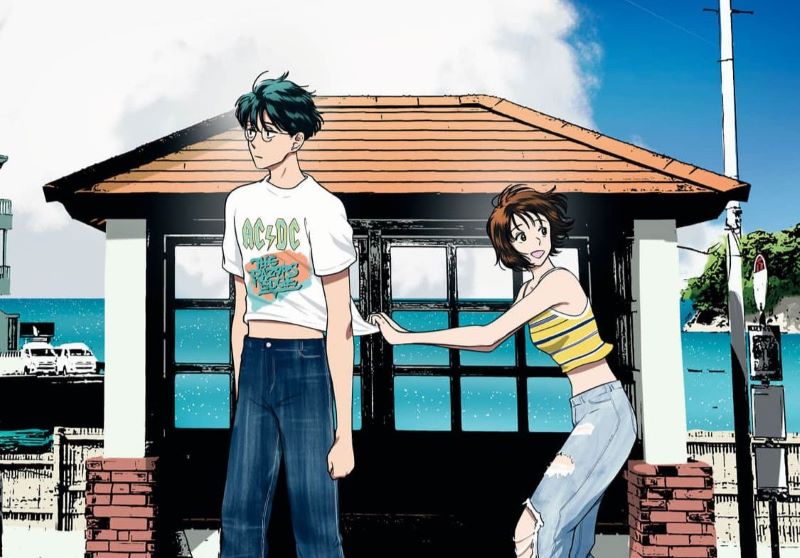
Another fairly light reading week. I wrote about 18k words for a new story I'm thinking about (The Lamb is still ongoing but a fire started burning for another idea and I want to see it to the end). Yes it's another K9-verse story, it's called The Wolf in June and it's set in northern Finland in 2007 (or thereabouts).
- オオルリ流星群 (ページ202-265)
- Cleanness page 30-87
- The Handmaid's Tale (TV) S2E9-S4E3
- 8月31日のロングサマー 第12巻
オオルリ流星群
I finally got to a part in this book that made me cry, though it's a bit too little too late maybe. We learn about the history of 彗子 (keiko/suiko)'s name, which sounds like it shouldn't matter but it turns out she was born on the night that a once-every-13-years meteor shower happens. It turned out the visibility of the shower was low that night and her father was disappointed, but when she was born they decided she was their shooting star and named her that. As it turns out this october (when she turns 39) the meteor shower will be returning, so the gang decide to set october as the deadline to finish the observatory so they can do a grand opening on the day.
Hisashi, Chika, and Osamu are watching old tapes they borrowed from Kazuya's house and they find footage filmed by Keisuke on the day of the school festival (an event he claimed to have not attended). In the footage he calls Keiko "Keiko" (he normally used Suiko, her nickname) and she responds with Keisuke (she normally used his surname+san). Chika feels betrayed by this and confronts Keiko who reveals that yes, they had a relationship and he followed her to Tokyo when she went to university. She was pregante but got an abortion because she didn't want to interrupt her education and she suspects that Keisuke drank himself to death over the whole thing.
The latest chapter was just focused on Hisashi bringing his family into the observatory building project. There's so much building stuff and it's very boring.
Cleanness
Finished the first of three parts in this book. The last two chapters of this part were Gospodar and Decent People, both I liked quite a lot.
Gospodar was a very interesting chapter recounting the main character's sexual encounter with a gay dom. They hooked up online and there's a great deal of secrecy to the whole thing, so like What Belongs to You, I could see the incidental comments at the start and end about how the man couldn't be seen by his neighbours indicated an asymmetrical power dynamic. The main character plays the role of a submissive during the scene, and it starts with him being ordered to strip naked before he can enter the apartment. When asked what he wants, the main character basically says "I want to be nothing". This whole play session, including its messy, unpleasant ending felt very believable and I loved reading it from start to finish.
Decent People was about a Bulgarian protest that the main character is attending. I enjoyed the main character's perspective of this Bulgarian protest/rally and in particular there was a really salient plot point where a small cohort of gay rights advocates are protesting alongside the crowd only to be pushed out and beaten up by the end of it. This was aesthetically connected to an observation the main character makes that the protesters are cleaning the streets after themselves to leave a "clean" / "decent" image for the public/media to increase their chances of success. The gay membership are seen as indecent and cleaned up with the mess.
Within the writing I also just empathised with the main character's sense of exclusion. Though he agreed that the country needed fixing, his spirit clearly isn't saturated by a lifetime of pain over this particular issue in the way that native Bulgarians do so at several points we see how he's too uncomfortable to join their chants or to make big signs of membership. There were a lot of interesting ideas in there. It was a good chapter.
The Handmaid's Tale (TV)
The Handmaid's Tale is like Prison Break. June Osborne keeps getting opportunities to leave hell but the bottom line is so juicy, so she finds herself stuck in prison (a TV show) for one more season. Season 2 had some interesting events, like the birth of Nicole in the abandoned building, and Emily stabbing Aunt Lydia, but the final episode, especially the final moment between June and Joseph Lawrence, just made me cringe. Season 3 was sort of a wet blanket, though I liked seeing Washington a little bit (and especially Christopher Meloni's character (he's the guy from Law & Order SVU and he plays the nice pediatrician in one episode of Scrubs)) who I was sad to see was written out of the story pretty quickly. There was a scene of implied homoeroticism between him and Commander Waterford that would have been interesting to explore, but instead I guess the idea was just "he's a perv" and June gets his ass for it. When June gets a pistol in season 3 the show devolves into something like a comedy. She's constantly waving it around making threats and Joseph is just like "whatever". It's also the season where she properly breaks bad, leaving Mrs Lawrence to overdose and threatening the Martha with her pistol. Season 4 hasn't gotten much better, and it's increasingly funny how many excuses they have to make to keep June alive. She gets 87 children out of the country, which one can only imagine would be interpreted as 87 counts of "child endangerment" to Gilead, but somehow Aunt Lydia spins it as an excuse to keep her around because "we need all the handmaids we can keep". At least cut off a finger or something, guys, it's weird how toothless their punishments are. Even during the torture in season 4, which was quite interesting to watch, she's able to get out of having a fingernail pulled with a lie. Their punishment for her lying was just other types of torture that couldn't possibly leave a permanent mark on Elizabeth Moss's skin. She's gotta be able bodied for the revolution, I guess.
It sounds like I hated my time watching the show but it's not really like that, I think it's just a case where the stakes feel lower as June gets away with things. I liked seeing Serena lose her pinky for reading in the court room. I think she's a great character who has developed so much since the start of the show. I liked seeing Aunt Lydia's backstory and seeing how she had a moment where her future could have been different, but a single act of rejection had her backslide and take her hurt out on others. I also like that in the flashback she's not totally wrong. I like that the "before time" really does reflect issues we're facing today. Parents are exhausted and overworked and children aren't given quality time as a result, and it's something that theoretically could be resolved by the parents taking more responsibility, but it's also a consequence of a massive sociopolitical and economic crisis that makes being a parent, let alone a single parent, feel impossible. Lydia taking on the role of the "Aunt" in the before time, and supporting the struggling single parent with her spare time genuinely seems like a solution that was working (though how many children she can give that to would spread thin quickly), but resentment spoils the whole thing.
8月31日のロングサマー
You know this is a read-on-sight manga for me. As soon as it came out I read it. This volume starts with Mana-chan's mother urging her home, and there's a really negative energy throughout the whole interaction. As it turns out that energy wasn't wholly her fault, she was just passing down an aching frustration that her husband (Mana's father) passed onto her. The volume focuses largely on Mana taking the lessons she learned from her time with Takaya and Kana and snapping her parents out of their cycle of frustration. Takaya and Kana also show up and break the tension in their own way, and they're able to finish Mana's birthday in a tent in the backyard of her house. It was a bit of a tearjerker volume and it went by quickly just like the others. I love Long Summer.