Reading Report: 03 May 2026
- オオルリ流星群 (ページ1-60)
- A Kite + メゾフォルテ
- 奴隷立国 + 家族の禁断肖像
- Jorge Luis Borges Collective Works page 1-61
オオルリ流星群
I started reading a new, non-erotic book. Can you believe it? This is a novel by Iyohara Shin, the author of 月まで3キロ, a book that I really enjoyed when I read it a few years ago. I don't know why I never pursued another book of his, so this is my opportunity to correct that error.
Unfortunately so far it hasn't really given me what I hoped for out of Iyohara's writing. It's been a long time since I read 月まで3キロ so maybe I'm just constructing a memory, but I recall it grabbing me a lot sooner than this book.
This story is about Hisashi, a middle-aged pharmacist with a wife and two sons. He's depressed, basically. He's having a mid-life crisis. He reconnects with three of his old high school friends and each has reached mid life in different ways. Osamu, a male friend, is thinking about a career change at 45, an idea that frightens Hisashi who feels like his course in life has already been set. Chika, a level-headed female friend, seems to be fairly happy with her life and sort of illustrates a person who is content in mid life (though she is the point of view character for half the chapters so we'll see how true that remains). And Keiko, an introverted female friend, has just returned to her home town after working as an astronomer. Keiko's return is sort of the instigating incident. She explains to her friends that she wants to build a new observatory nearby, and I guess they're gonna have a little reunion and help her out.
Some of the story is also told through flashbacks to when the high school group were all together. Back then there were two other members, Ume-chan and Keisuke. Keisuke was the group leader, a real nice guy, member of the baseball team, and very charismatic, but sadly he dies shortly after the events of the flashback. Ume-chan is another introverted character, like Keiko. He's an audiophile and very concerned (positively) with radiowaves. After highschool he became a shut-in and the middle-aged group have only seen shadows of him since. I'm sure he'll enter the party for real when they need a radiowave guy.
Various 梅津泰臣 works
This week I watched a handful of anime which were connected by Umetsu Yasuomi leadership.
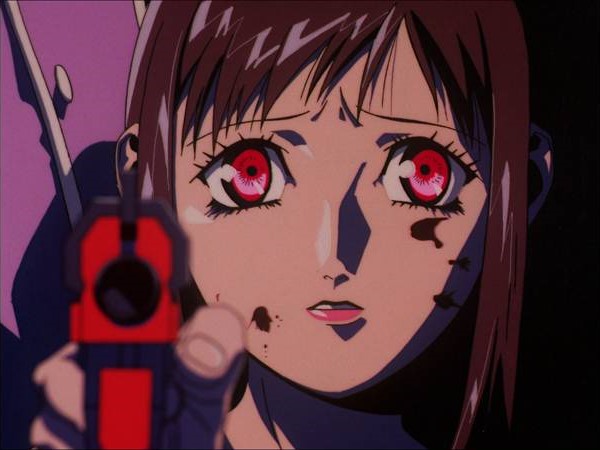
A Kite
This was a really cool anime. I'm certain that I'd been told about it in the past by people who (correctly) insisted that it was peak. Well, yeah, it's peak. The story is about a young female assassin who performs hits on behalf of a corrupt police officer. She falls for another assassin, a boy roughly her age, and they attempt to escape their situation.
メゾフォルテ
This was also absolutely amazing. It's about a trio of mercenaries who get up to all kinds of hijinks. There's a lot of physical humour and you can really see in Umetsu works how he's inspired by Hollywood action films. After the trio botch a job they become the target of a violent heiress who has a mysterious connection to the main female member of the protagonist trio. The fights, the sex scenes, and all of the quiet moments are all so sooo good. 10/10 OVA.
As a minor side note, I find that in Japanese media I tend to only give my best reviews to deeply emotional stories. Mezzo Forte isn't really emotional, but I think it does things that you just don't see in anime. It's energetic and dirty and it was perfectly paced. Umetsu's work is the kind that makes all other anime look artificial and thin by comparison.
Various 海明寺裕 works
I believe with this lot of manga I only have one prominent R18/NSFW Kaimeiji book to finish, and then the rest are general audience works, maybe?
奴隷立国
This manga is very interested in establishing a historical and meaningful context for its system of slavery, though it's pretty weak in that attempt, and I found the lack of focus on individual stories to be a missed opportunity. Early on there are hints to develop certain victimised characters, but they're ignored in favour of the history lesson about the world. Maybe this is a good example for why we shouldn't just focus on creating a logical system at the expense of a human story at the centre of the writing.
家族の禁断肖像
Another manga anthology that falls into the "humiliating women" category. It has some fun chapters, like the perverted train cart (a common trope but it's done pretty well here; I especially liked how the men had this unity in their actions, offering to help each other, politely advising each other that their stop was coming, offering to film when another guy's camera runs out of storage), and one where the storytelling device is blog posts by a girl who has invented a "master" for herself (she is her own master) which she uses to permit herself to do lecherous things. As with all the anthology books, I just think the stories need more time to develop.
Jorge Luis Borges Stories
Tlön, Uqbar, Orbius Tertius
A short story about a fictional planet with a culture and way of thinking completely unlike any Earth language or culture, where time, space, and even the identification of physical and abstract nouns is not strictly made. It's a culture where the present only exists, there is no causality, and "doing" is as real as "being". It's a very difficult philosophy to wrap my head around, but it's a fun, short story to read.
The Garden of the Forking Paths
This is technically the second time I've read this story. My brother gifted me the book of Borges short stories for my birthday a few years ago and this was the first one in the book. I read it and then got distracted by the rest of my life. Reading it again I find the premise somewhat interesting, dealing with a kind of quantum, multi-consequential world, but I think it's just a bit too high brow for me, and I didn't really connect with the main character.
Funes, His Memory
This is definitely my favourite Borges story so far. His writing sort of balances a detached, scientific style and a deeply personal style, and this leans really deeply into the latter, which enhances the meaning of the former. Funes is just some kid, but after an accident where he bumps his head his perception of the world, time, memory, sensation, everything is maxed out. The story is written from the perspective of an acquaintance of Funes who is remembering the last day he saw him before his death. The perspective being so subjective and coloured by the writer's grief plays against Funes' inability to "do" humanity. Every part of his life has become alien just because he's unable to filter the world into a flowing subjective experience. I cried.